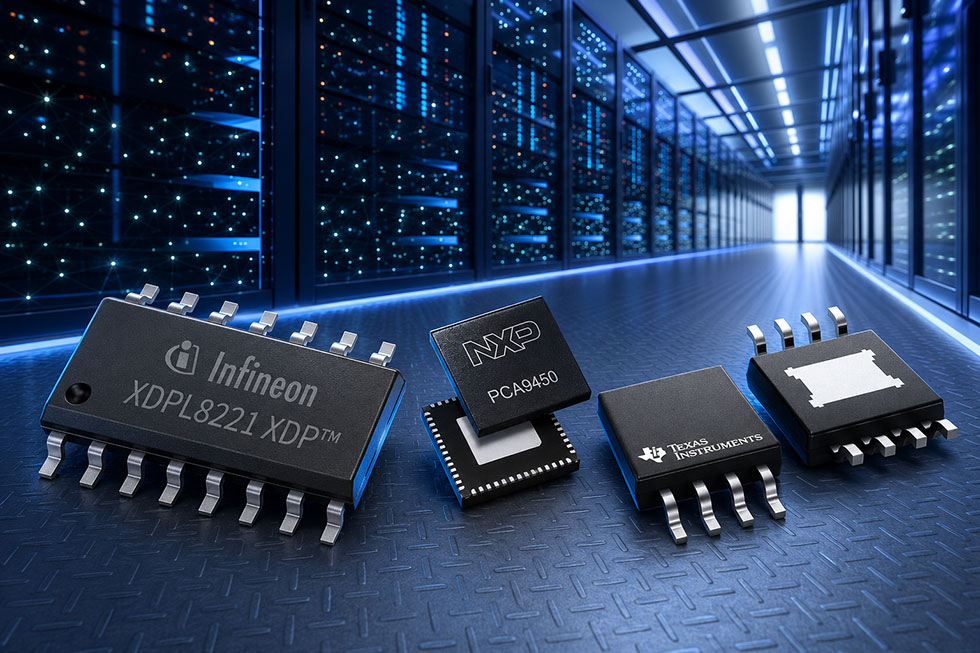
Key Takeaways: Power Management ICs are becoming a selective AI-driven component shortage. AI server demand is pushing rack power toward 1 MW while 8-inch foundry utilization approaches 90% in 2026. That pressure is extending lead times for converters, regulators, and drivers across industrial, automotive, aerospace, military, and MRO markets, making early sourcing and verified inventory checks necessary.
Power Management ICs could be the next domino to fall in the AI component supply chain. Based on the requests coming across my desk in 2026, the answer is yes, but this is developing into a selective shortage.
Specific converters, regulators, drivers, packages, and grades are becoming harder to secure as AI infrastructure consumes more power components and mature-node production capacity.
The pressure reaches well beyond data center racks. AI servers need large quantities of PMICs and Advanced Driver ICs to convert, regulate, sequence, monitor, and protect multiple power rails. High-resolution displays add another demand source, while automotive, industrial, medical, military, aerospace, and MRO buyers compete for devices made on many of the same manufacturing processes.
At Summit Electronics, we work as an electronic parts supplier for current, allocated, hard-to-find, and obsolete components. That gives us a direct view of quote activity, shifting availability, rising prices, and the part numbers buyers are struggling to find.
We have more than 2 million parts in stock and access to a worldwide distribution network.
What Are Power Management ICs?
These analog integrated circuits control the flow of electricity through electronic equipment. They convert voltage, regulate current, start power rails in the correct order, charge batteries, monitor faults, and protect circuits from excess heat or current.
 Common power-management functions include:
- DC-DC step-down and step-up conversion
- Low-dropout voltage regulation
- Power sequencing and reset control
- Battery charging and fuel gauging
- Load switching and power-path control
- Overvoltage, overcurrent, and thermal protection
A modern server board may need separate power rails for GPUs, CPUs, memory, storage, networking, fans, and management controllers. Each rail must remain stable as workloads change within microseconds. A failure in one small regulator or controller can hold up an entire high-value system.
A modern server board may need separate power rails for GPUs, CPUs, memory, storage, networking, fans, and management controllers. Each rail must remain stable as workloads change within microseconds. A failure in one small regulator or controller can hold up an entire high-value system.
Why AI Servers Are Driving Demand for PMICs
AI accelerators draw heavy current and create rapid load changes. Power must move from the utility feed through several conversion stages before it reaches a GPU or processor. Every stage adds demand for converters, controllers, gate drivers, smart power stages, sensors, protection devices, MOSFETs, and capacitors.
Texas Instruments reports that AI rack power could exceed 1 MW within the next two to three years. TI is developing architectures that move from 12V distribution to 48V and then to 800 VDC. Its CSD965203B smart power stage supplies 100A of peak current per phase, while the CSDM65295 module delivers up to 180A of peak output current.
Those figures show why AI power demand is different from a normal server upgrade. Higher rack density calls for greater current capacity, tighter voltage control, lower conversion losses, and better thermal performance. The supporting power system must scale with every added GPU.
Our AI component sourcing work also shows that the pressure does not stop with processors. Memory, storage, voltage regulators, transistors, MOSFETs, capacitors, and other supporting devices can delay a build when one required part becomes allocated.
Multiphase controllers coordinate the high-current power rails used by GPUs and CPUs. Smart power stages switch these large currents, while gate drivers control MOSFETs and other power switches. Higher current density, added heat, faster switching speeds, and tighter voltage tolerances are increasing demand for each component.
Sequencers and monitors start power rails in the correct order and detect faults before they damage server hardware. Display drivers control pixels, timing, and backlighting. As AI servers add power rails and data centers use higher-resolution displays, suppliers face greater pressure to meet performance requirements and rising order volumes.

Mature-Node Capacity Is the Main Bottleneck
Many analog and power integrated circuits rely on established manufacturing processes instead of the smallest logic nodes. High-voltage products often use 8-inch wafers and 90 nm or larger processes because these platforms support proven analog behavior, higher voltages, and long product lives.
TrendForce projects that average 8-inch capacity utilization among the ten largest foundries will approach 90% in 2026, up from about 80% in 2025. It expects utilization to remain above 80% through the first half of 2027. Global 8-inch capacity is also expected to remain in negative growth during that period.
Those production lines cannot add meaningful output overnight. Moving a qualified device to another foundry or process may require recipe transfers, electrical validation, package qualification, reliability testing, and customer approval. Automotive, medical, aerospace, and military programs may require added reviews before accepting a manufacturing change.
Foundries are also assigning more mature-node capacity to power products with stronger pricing and margins. That shift can leave fewer wafer starts for general-purpose regulators, display drivers, older packages, and low-volume components used in long-life equipment.
Request a quote by manufacturer, full part number, quantity, package, condition, and deadline. We will start working to find the strongest available supply option before lead times grow.
Why Advanced Driver ICs Face Similar Pressure
Advanced Driver ICs sit on two sides of the demand increase. Gate drivers control MOSFETs and other power switches inside converters. Display driver chips manage pixels, timing, brightness, and backlighting in screens.
4K and 8K displays contain far more pixels than standard HD panels. Higher refresh rates require those pixels to update more frequently. OLED displays, Mini LED backlights, gaming monitors, vehicle displays, professional imaging systems, and digital signs place added demands on current control, timing, thermal performance, and power efficiency.
Many display drivers use mature high-voltage processes. When foundries move capacity from display driver production toward higher-margin power applications, panel manufacturers may face longer schedules and reduced output.
Buyers maintaining older display parts have an added problem. Panel interface, resolution, timing, dimensions, and firmware can limit substitution options.

Texas Instruments Part Numbers Buyers Keep Requesting
The shortage becomes clearer when looking at the actual quote requests we receive. I have been getting many inquiries for Texas Instruments DC-DC step-down converters and regulators, including:
- TPS62260: A 2.25 MHz, 600mA synchronous step-down converter with a 2V to 6V input range
- TPS5430: A 500 kHz, 3A step-down converter with a 5.5V to 36V input range
- TPS62840: A 750mA step-down converter with a 1.8V to 6.5V input range and 60 nA typical quiescent current
These devices serve different power requirements and are not interchangeable. They also do not all go into AI servers. Their quote activity shows how power-component pressure can spread into portable electronics, industrial controls, connected devices, test equipment, repair inventories, and other product lines.
It has become harder to meet demand when buyers need a specific suffix, package, reel quantity, date code, temperature grade, or approved manufacturer. We are still filling these requirements by combining stocked inventory with allocated lots and our worldwide sourcing network.
The earlier you send us the full part number and specifications, the more time we have to locate a qualified supply option.
Which Industries Face the Greatest Supply Risk?
Any market that shares foundry, packaging, or testing capacity with AI power products can feel the effect. The highest risk usually appears when an approved design depends on one exact device.
- Automotive manufacturers need converters, battery-management devices, LED drivers, and motor-control chips.
- Industrial automation systems require stable power for sensors, controllers, robotics, and communications.
- Medical equipment may depend on a specific package, revision, grade, and documented source.
- Aerospace and military systems may keep approved integrated circuits in service for decades.
- Consumer electronics compete for regulators and display-related components produced in high volumes.
- Energy and MRO teams may need an older device to repair a board that cannot be redesigned.
This is why I do not treat the current market as a shortage affecting only AI companies. A foundry can redirect capacity toward AI power devices, then a maintenance team may struggle to source a regulator for a control board built years earlier.
Supply Warning Signs to Watch Through 2027
A shortage in PMICs rarely begins with every product family becoming unavailable at once. It usually appears as a series of smaller changes across manufacturers, packages, and grades.
Watch for:
- Factory delivery dates that move more than once
- Reduced order confirmations or allocation notices
- Noncancelable and nonreturnable purchasing terms
- Price increases without a firm delivery commitment
- Package or temperature-grade options disappearing
- End-of-life and last-time-buy notices
- Spot-market listings with weak traceability
- Sellers that cannot confirm quantity, location, or condition
In my experience, a quoted factory date is not the same as available inventory. If that date moves, remaining qualified stock may sell before your next purchasing review.
How to Reduce Power Management IC Supply Risk
You can take several practical steps before a delayed component stops production or an MRO repair.
- Rank parts by their ability to stop a build, repair, or service program.
- Record the complete manufacturer number, suffix, package, revision, temperature range, and date-code requirements.
- Confirm physical stock instead of relying on a catalog listing or estimated factory date.
- Track end-of-life notices and last-time-buy deadlines.
- Ask engineering teams to identify approved alternates while the original device remains available.
- Build practical safety stock for single-source and long-life parts.
- Review traceability, condition, packaging, and testing options before approving a source.
- Contact an experienced electronic parts supplier before the requirement turns into a line-down emergency.
Do not approve a substitute from a short product description alone. Input range, output current, topology, switching frequency, compensation, protection features, pinout, package, thermal limits, and qualification grade can all affect compatibility.

How Summit Electronics Helps Source Allocated Components
I have spent more than 30 years helping buyers locate current, allocated, hard-to-find, and obsolete electronic components. Our company was founded in 1961, and the principle behind our work remains the same. We provide direct, personal sourcing support and work to keep component shortages from interrupting our customers’ production and repair programs.
As an electronic parts supplier, we combine more than 2 million stocked parts with a worldwide distribution network. Our inventory and sourcing coverage include semiconductors, diodes, transistors, IGBTs, MOSFETs, switches, capacitors, electron tubes, power rectifiers, SCRs, relays, voltage regulators, and integrated circuits.
We support military, aerospace, robotics, energy, manufacturing, MRO, and other buyers. Our team reviews the complete part number, quantity, package, condition, acceptable alternatives, and delivery deadline before we quote. That part-level attention matters when a one-letter suffix can change the package, temperature rating, or qualification status.
My advice is simple. Start the sourcing conversation before your regular channel runs dry. You will have more options when we can search verified inventory, compare qualified sources, and address testing or traceability requirements before the part becomes an emergency.
Source Power Components Before Lead Times Stretch Further
The current supply pressure will not hit every power device at the same time. One allocated converter, controller, or driver can still delay a complete server, control board, display assembly, or repair project.
At Summit Electronics, we are meeting difficult demand through stocked inventory, worldwide sourcing access, fast responses, and part-number-level support. Click here or call us toll-free at (800) 226-6960.


