Electronic Parts Supplier Checklist for OEMs, MRO Teams, and Repair Buyers

  • Home
  • Electronic Parts Supplier Checklist for OEMs, MRO Teams, and Repair Buyers
Electronic Parts Supplier Checklist for OEMs, MRO Teams, and Repair Buyers Summit Electronics June 22, 2026

Electronic Parts Supplier Checklist for OEMs, MRO Teams, and Repair Buyers

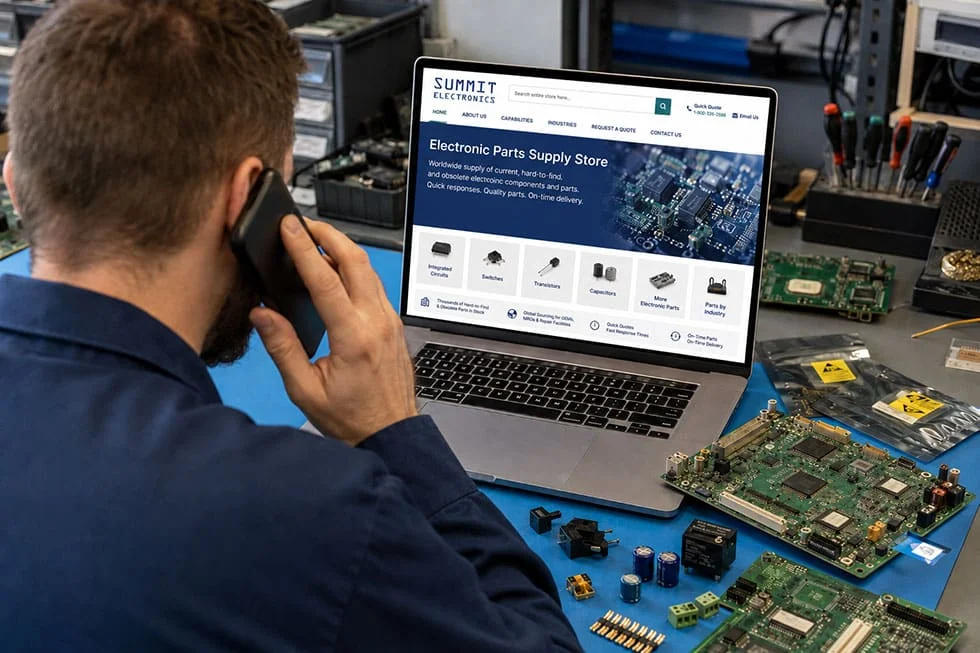
MRO technician calling Summit Electronics while sourcing hard-to-find electronic components from a laptop at a repair workbench.

Key Takeaways: An electronic parts supplier helps OEMs, MRO teams, and repair buyers source exact components when standard channels fail. The right partner verifies part numbers, confirms availability, checks condition details, and supports obsolete sourcing so teams can reduce downtime, avoid wrong-part orders, and keep production or repairs on schedule.

A reliable electronic parts supplier can save your production line from turning one missing component into a full-blown fire drill. 

Our team helps OEMs, MRO teams, repair buyers, engineers, and procurement teams source exact components before downtime spreads.

Standard distributors work well when stock is available, lead times are short, and the manufacturer still supports the part. The real test comes when the OEM shows no stock, the part is obsolete, or your repair window is measured in days instead of weeks.

Summit Electronics helps buyers find current, allocated, hard-to-find, and obsolete electronic parts from our base in Boca Raton. Our team supports one-to-one sourcing, fast quote responses, and production-line continuity for companies that need the right part without wasted time.

What a Parts Supplier Actually Does

A parts supplier does much more than pull parts from a shelf.

For OEMs and MRO teams, the job often includes sourcing exact components, checking availability, confirming part details, and helping buyers avoid delays. A supplier may support production, field repairs, plant maintenance, aerospace systems, industrial controls, automotive electronics, robotics, telecom equipment, and legacy machinery.

Summit Electronics CTA graphic for fast sourcing help with current, obsolete, and hard-to-find electronic components. A strong supplier can help with:

  • Current production parts
  • Allocated components
  • Obsolete parts
  • Hard-to-find inventory
  • Passive and active components
  • Replacement parts for older equipment
  • Parts used across multiple industries

Our current, hard-to-find, and obsolete electronic components and parts support buyers who need practical sourcing help, not generic catalog searches.

When Buyers Need More Than a Standard Distributor

A standard distributor can help when the part is easy to find. But many OEM and repair problems start when normal channels run dry.

That can happen when:

  • The OEM no longer supports the part
  • Authorized distributors show zero stock
  • A production line needs a replacement fast
  • A repair buyer needs the same part number
  • A design uses legacy components
  • A manufacturer announces end-of-life status
  • Lead times stretch past the repair deadline

This is where buyer experience matters. An MRO team may need one component to bring equipment back online. An OEM may need a small batch to finish production. A repair shop may need the exact package, tolerance, date code, or manufacturer match.

When the original manufacturer cannot help, our guide on what to do when the electronic components OEM is out of stock gives buyers a practical next step.

Repairman is checking circuit board of electronic device.

Electronic Parts Supplier Checklist for OEMs and MRO Teams

Use this checklist before you send a quote request or approve a supplier.

checkox 1. Confirm the Exact Part Number

Start with the full part number from the board, datasheet, BOM, label, or old purchase record. One missing suffix can change the package, tolerance, voltage rating, temperature range, or lead finish. Send photos when possible. A clear image of the marking, package, and board location can help reduce errors.

checkox 2. Identify the Manufacturer

Some part numbers appear across different manufacturers. Do not rely on the number alone when the manufacturer matters. List the original manufacturer when you have it. If the manufacturer no longer supports the component, ask the supplier to search for exact stock first before discussing alternatives.

checkox 3. Check Package Type and Mounting Style

A part with the right base number may still fail the fit check if the package is wrong. Confirm details such as:
  • DIP, SOIC, QFP, BGA, TO package, or module type
  • Through-hole or surface mount
  • Pin count
  • Lead spacing
  • Case style
  • Board clearance
For repair buyers, this step can prevent rework.

checkox 4. Review Electrical Ratings

Electrical specs matter as much as the part number. A small mismatch can create failure risk. Check voltage, current, resistance, capacitance, speed, tolerance, temperature rating, power rating, and switching characteristics. Match the datasheet to the application before approving an alternate.

checkox 5. Ask About Condition

Condition terms can vary. Ask for clear details. Common conditions include:
  • New
  • New old stock
  • Surplus
  • Refurbished
  • Pulled
  • Used
For production and regulated applications, condition details may affect approval, testing, and documentation.

checkox 6. Ask About Date Codes

Date codes matter when parts have shelf-life concerns, long storage history, moisture sensitivity, or production traceability requirements. Ask for date code availability before you lock in a repair plan. This can help avoid surprises after the part arrives.

checkox 7. Confirm Availability Before Planning Downtime

Do not schedule a shutdown based on an unconfirmed stock claim. Ask for real availability, quantity, location, and expected ship timing. We have access to over 2 million parts in stock, 40,000 inventoried items, and 90% overnight deliveries, which matters when your team needs a fast answer.

checkox 8. Ask How Rare Parts Are Sourced

Rare inventory needs real sourcing work. A supplier should know how to search across trusted channels, excess inventory, global networks, and legacy stock sources. Our guide on how to source hard-to-find electronic parts explains why vetted suppliers, global access, and quality checks matter when standard searches come up empty.

checkox 9. Review Quality Checks and Supplier Screening

Counterfeit and nonconforming parts remain a real risk in the electronics supply chain. ERAI tracks suspect counterfeit and nonconforming electronic parts, plus high-risk suppliers, through its industry risk database. Ask how the supplier screens sources, reviews condition, and checks part details before shipping.

checkox 10. Keep Records for Repeat Orders

A good sourcing record saves time later. Keep notes on:
  • Approved part numbers
  • Alternate part numbers
  • Manufacturer matches
  • Date codes
  • Supplier contacts
  • Test results
  • Past quantities ordered
  • Equipment models tied to the part
This record helps your team move faster the next time the same component fails.

How to Verify Hard-to-Find and Obsolete Electronic Parts

Hard-to-find and obsolete electronic components need extra attention because inventory may come from surplus stock, old production runs, excess lots, or retired systems.

Verification should include the part number, manufacturer, package, markings, condition, and required documentation. For higher-risk components, buyers may also need inspection, testing, or traceability support.

A specialized electronic components store like ours can help buyers avoid broad marketplace searches and focus on parts that match the application. That matters for older machines, defense equipment, industrial controls, and repair programs where one wrong component can create repeat failures.

The Semiconductor Industry Association reported that global semiconductor sales reached $791.7 billion in 2025, up 25.6% from 2024. Demand at that scale can put pressure on supply channels, especially when buyers need older, allocated, or exact-match parts.

Why Part Numbers, Package Types, Date Codes, and Datasheets Matter

Electronic parts can look similar and behave differently.

A part number may include details about package type, tolerance, lead finish, speed grade, temperature range, voltage rating, or revision. A datasheet helps confirm those details before purchase.

For OEMs, the wrong part can delay production or trigger engineering review. For MRO teams, the wrong part can extend downtime. For repair buyers, the wrong part can turn a simple fix into a second repair.

Before ordering, send us as much information as you can:

  • Full part number
  • Manufacturer
  • Quantity needed
  • Date code requirement
  • Package type
  • Photos of the part
  • Datasheet or BOM notes
  • Equipment model
  • Urgency level
  • Acceptable alternates, if already approved

If the part has stopped production, our article on how to find obsolete electronic parts quickly explains why speed, verification, and planning all matter and that we are more than prepared to handle the task.

Warning Signs a Supplier May Create Risk

The wrong supplier can cost you time before you ever receive a part.

Watch for these warning signs:

  • Vague stock claims
  • No useful part details
  • Slow replies
  • Poor understanding of obsolete parts
  • Pressure to accept an alternate too quickly
  • No clear condition information
  • No sourcing process
  • No support for OEM or MRO urgency
  • No understanding of repair downtime

A supplier should help you make a better buying decision. If the answer feels unclear, ask more questions before placing the order.

How Summit Helps Source Current, Allocated, and Obsolete Parts

Summit Electronics is focused on personal service, production-line support, and responsive sourcing for buyers who need exact components.

Our personal service and production-line support help buyers with orders that may be small, large, unusual, or time-sensitive. That fits how OEMs, MRO teams, and repair buyers work in the real world.

We support buyers with:

  • Current electronic parts
  • Allocated components
  • Obsolete parts
  • Hard-to-find inventory
  • Passive and active components
  • Industry-specific sourcing
  • International import and export support
  • Same-day or next-day quote responses

When you need a responsive electronic components store, our Boca Raton team brings local accountability, nationwide shipping, and global sourcing reach together.

Local Support With Global Sourcing Reach

Fast communication matters when a line is down or a repair is waiting.

Our team works from Boca Raton and supports buyers across the country for various industries that depend on new parts and obsolete electronic components. That includes defense, energy systems, consumer electronics, HVAC, oil & gas, and semiconductor manufacturing repair needs.

Our global sourcing reach gives you more ways to find the right component when standard channels fail.

That mix helps buyers reduce delays, avoid wrong-part orders, and keep equipment moving.

FAQs

What should buyers look for in an electronic parts supplier?

Look for fast communication, exact part matching, current and obsolete sourcing ability, quality checks, clear condition details, and experience with OEM and MRO needs.

Why do OEMs and MRO teams need different sourcing support?

OEMs often need parts to keep production moving. MRO teams often need parts to restore equipment, reduce downtime, or support older systems. Both groups need accuracy, speed, and clear sourcing support. We provide it all!

Can obsolete electronic parts help avoid equipment redesign?

Yes. Exact obsolete parts can help extend the life of legacy equipment when redesign would cost more time, money, or engineering resources.

What information should I send before requesting a quote?

Send the full part number, manufacturer, quantity, condition needs, date code needs, datasheet, equipment model, photos, and deadline. This helps the sourcing team respond faster.

Get the Right Parts Before Downtime Spreads

A missing component should not control your production schedule.

When you need current, allocated, hard-to-find, or obsolete parts, work with a sourcing team that understands urgency, accuracy, and real-world repair pressure. Send the part number, quantity, and deadline so our team can help you find the right component fast.

Click here or give us a call toll-free at (800) 226-6960.