Ceramic capacitor aging is a predictable drop in capacitance that affects Class II and III MLCCs like X7R and X5R due to ferroelectric relaxation. This article explains the cause, typical aging rates, circuit impact, and how to design around it. |
How Does Aging Affect the Performance of Ceramic Capacitors? In Class II and Class III MLCCs, capacitance drops over time in a predictable, logarithmic way after the last heat event.
This is a normal material behavior in ferroelectric dielectrics such as X7R, X5R, and Y5V. The internal domains gradually relax from a high-energy state toward a more stable configuration, which reduces effective permittivity and capacitance.
At Summit Electronics, we source current, allocated, hard-to-find, and obsolete electronic components for teams building and repairing real hardware. That includes ceramic capacitors used in everything from aeronautics to consumer electronics and MRO repairs.

What Causes Aging in Ceramic Capacitors?
Aging shows up primarily in Class II and III MLCCs because their dielectrics are ferroelectric.
After the capacitor cools below its Curie point, the crystal structure supports polarized domains. Over time, those domains relax. Capacitance declines as a result. Murata describes this phase change behavior around the Curie temperature, which is commonly cited around 125°C for barium titanate systems.
Class I MLCCs, such as C0G or NP0, do not use ferroelectric dielectrics. They do not show the same aging mechanism.
Primary Electrical Effects of Aging
Capacitance decreases on a logarithmic curve
Aging is usually expressed as percent loss per decade hour. That means the change relates to each tenfold increase in time.
Common reference values you will see in manufacturer notes:
- About 2.5% per decade hour for X7R and X5R
- About 7% per decade hour for Y5V
- There is a representative curve of around 3% per decade hour after cooling below Curie.
The biggest drop typically happens early after the last heat event. After that, the curve flattens.
Loss factor and ESR can creep upward
As the dielectric relaxes, the dissipation factor can rise, and the effective ESR can shift. You may see slightly higher losses in filtering or coupling roles, especially when you run close to margins.
Impedance rises as capacitance falls
Lower capacitance means higher impedance at a given frequency. In practice, this can reduce the effectiveness of a bypass or filter capacitor at the lower end of its target band.
What Speeds Up or Resets Aging?
Heat resets the clock
If you heat a Class II or III MLCC above its Curie temperature, you effectively reset its aging. The internal crystal structure shifts back toward its post-manufacturing state, and capacitance increases toward its nominal value.
De-aging occurs when the dielectric is heated above the Curie point, and high-temperature conditioning is often used during testing and characterization to establish a consistent starting reference.
DC bias changes what you actually get in-circuit
Aging is time-based. DC bias adds a separate effect: capacitance reduction under applied voltage. That can make the first measured in-circuit value look lower than expected, even right after soldering. Voltage has an effect, though smaller than time and temperature in their overview.
How Aging Shows Up in Real Circuits
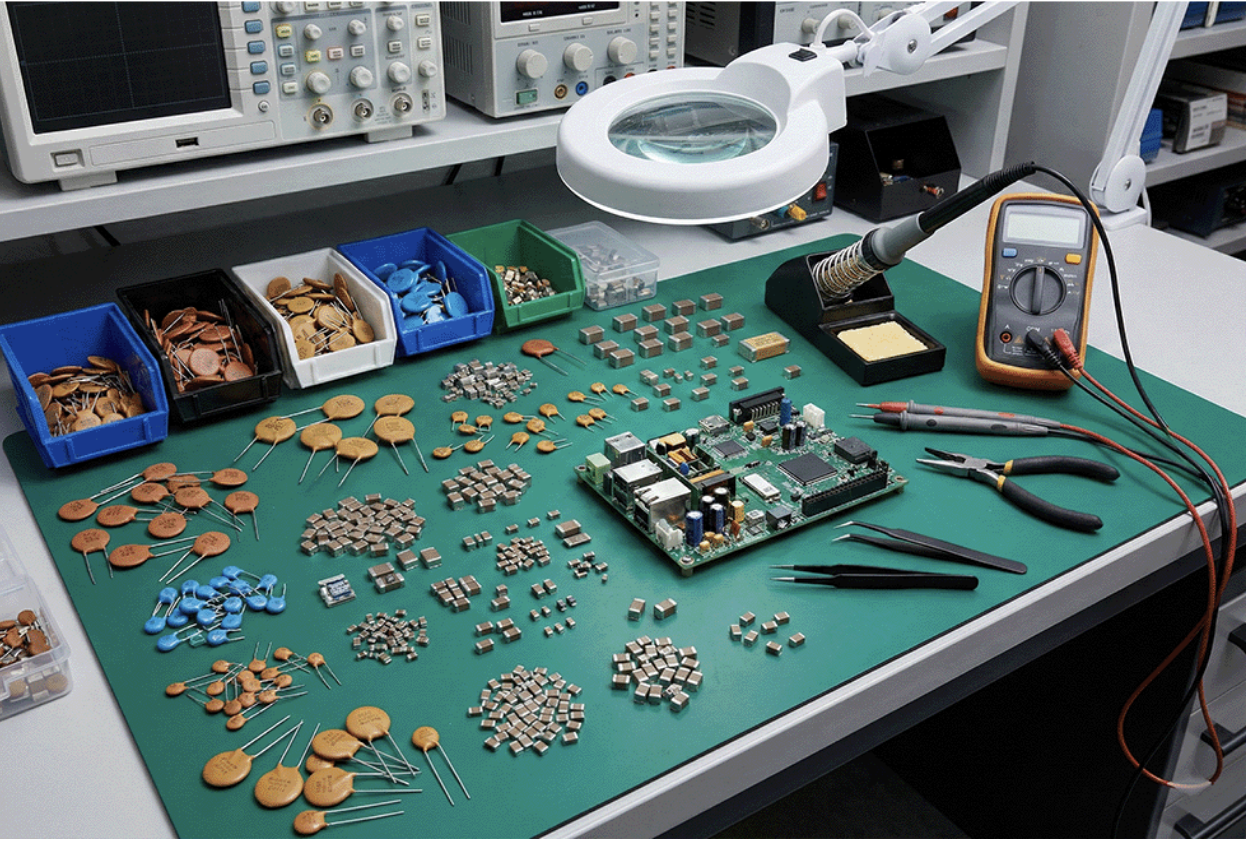
Ceramic capacitors do a lot of work in modern electronics. You see them in:
- Decoupling and bypass near microcontrollers and ASICs
- Power rail filtering and noise reduction
- AC coupling and DC blocking
- RC timing and oscillator networks
- Snubbers in power electronics
- RF networks, especially with Class I C0G parts
A common local decoupling approach uses 0.1 µF or 1 µF placed close to the IC power pins. Texas Instruments calls out those values as common choices in decoupling notes.
When capacitance drops with aging, you may see:
- Resonance points shift higher in filters and matching networks
- Ripple and noise increase on power rails when you sized capacitance too tight
- RC time constants drift in timing circuits
- More sensitivity to tolerance stacking when combined with DC bias effects

Manufacturers and Part Numbers We Supply
We help you source ceramic capacitors across major MLCC brands, including:
- Murata
- KEMET
- TDK
- Taiyo Yuden
- Yageo
Examples of popular specified parts and families we see requested include:
- KEMET C0603C104K5RACTU
- Murata GRM155R71C104KA88D
- Taiyo Yuden JMK105BJ105KV-F
- TDK CKG57NX5R1E476M500JH
If you support long-lived platforms, you already know why sourcing matters. We help teams keep builds moving when lead times spike, allocations hit, or you need obsolete electronic components for a qualified design that cannot change footprints.
Why Teams Use Summit Electronics for Ceramic Capacitors
Summit Electronics is a global distributor and sales agent for current, allocated, hard-to-find, and obsolete electronic components. Our inventory includes diodes, transistors, IGBTs, MOSFETs, switches, capacitors, electron tubes, power rectifiers, SCRs, integrated circuits, relays, and voltage regulators.
We support industries such as defense, aerospace, robotics, textiles, energy, automotive, and MRO repairs. We move parts through a worldwide distribution network with a focus on responsiveness, delivery speed, and competitive pricing.
We’ve built our reputation on reliability and speed. That’s why the world’s largest parts companies rely on us. Click here or give us a call toll-free at (800) 226-6960.