If you want to understand how to choose the correct resistor value for an LED circuit, the answer is simple.
 You calculate it using the supply voltage, the LED forward voltage, and the desired forward current. Then you apply Ohm’s Law to determine the resistance that limits current to a safe level.
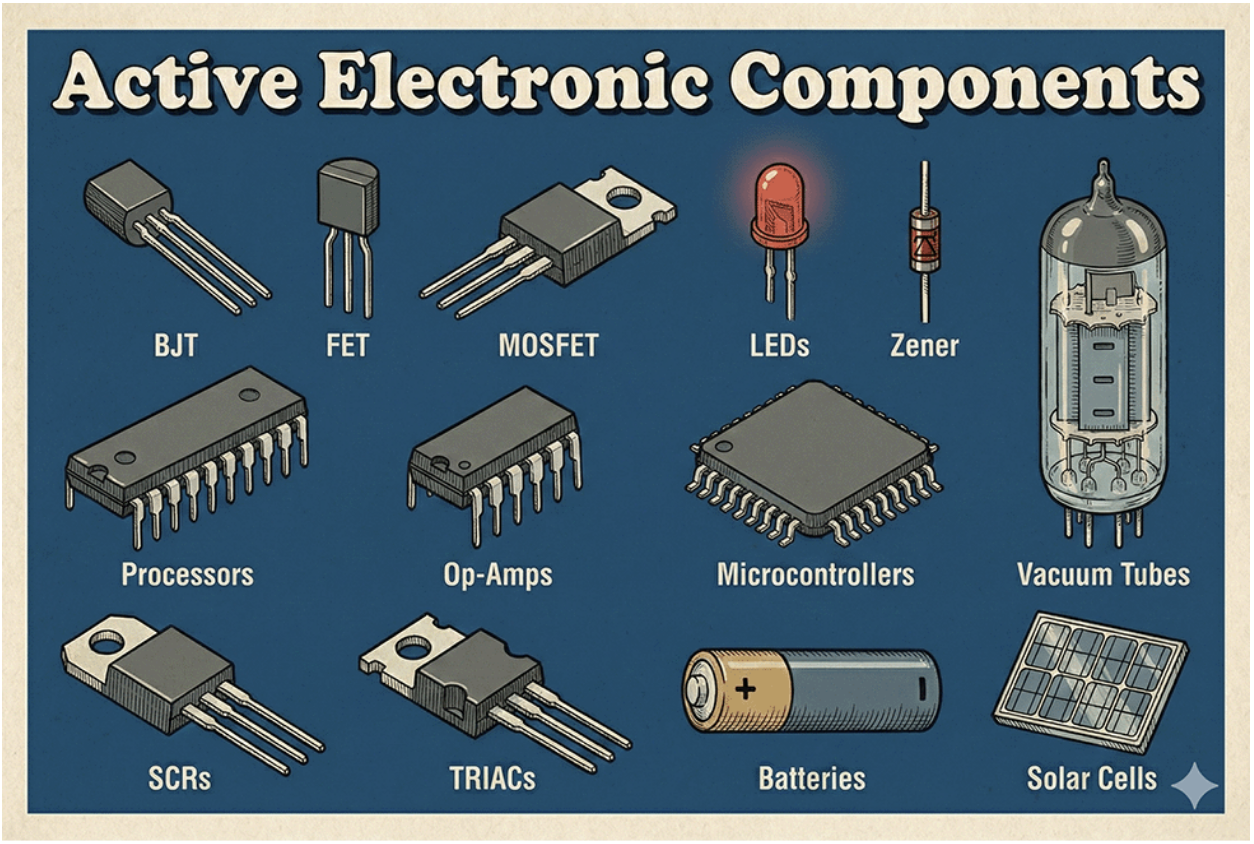
LEDs are current-driven devices (active components). They do not regulate current on their own. Without a properly selected resistor, current rises quickly, and the LED can fail almost instantly. A small calculation prevents premature burnout and protects the rest of your circuit.
At Summit Electronics, we help engineers and buyers source the resistors and other electronic components needed to build reliable systems. We are a global distributor and sales agent specializing in current, allocated, hard-to-find, and obsolete electronic components.
Our inventory supports defense, aerospace, robotics, energy, consumer electronics, HVAC, and MRO repair industries worldwide, just to name a few.
Why LEDs Require a Current Limiting Resistor
An LED operates at a specific forward voltage and forward current. Once that forward voltage is reached, current increases rapidly with only a small rise in voltage.
For example:
- A typical red LED has a forward voltage of about 1.8 to 2.2 volts
- A typical white LED ranges from 2.8 to 3.3 volts
According to the U.S. Department of Energy, LEDs can achieve lifetimes of 25,000 to 50,000 hours when operated within rated conditions. Overdriving them significantly reduces that lifespan.
A current-limiting resistor controls that current. It protects the LED and stabilizes circuit performance.
Short technical takeaway: LEDs require external current control to operate safely.
The Electrical Values You Must Identify First
Before calculating resistance, you need three values:
- Supply voltage, often labeled Vs
- LED forward voltage, labeled Vf
- Desired forward current, labeled If
Most indicator LEDs operate at 10 mA to 20 mA. Many manufacturers specify 20 mA as a typical maximum continuous current for standard 5 mm LEDs.
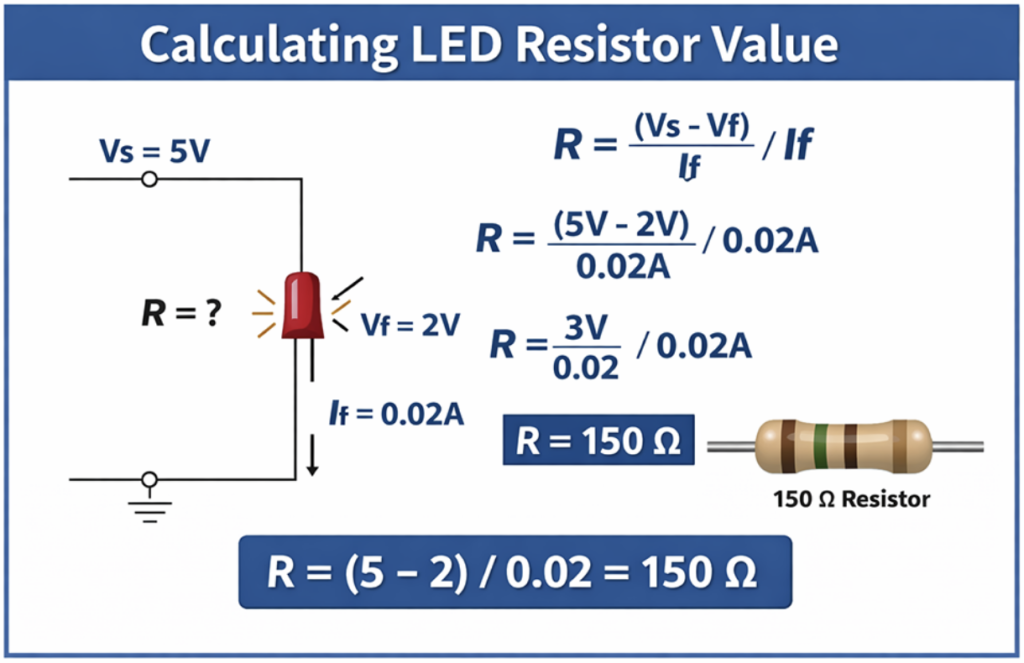
If your supply voltage is 5 volts, your LED forward voltage is 2 volts, and you want 20 mA of current, those values will drive your calculation.
Semiconductor device reliability studies show that excessive junction temperature significantly reduces component life. Controlling current directly controls heat.
Applying Ohm’s Law to Calculate Resistor Value
Ohm’s Law states:
R = (Vs − Vf) / If
Using the example above:
Vs = 5V
Vf = 2V
If = 0.02A
R = (5 − 2) / 0.02
R = 3 / 0.02
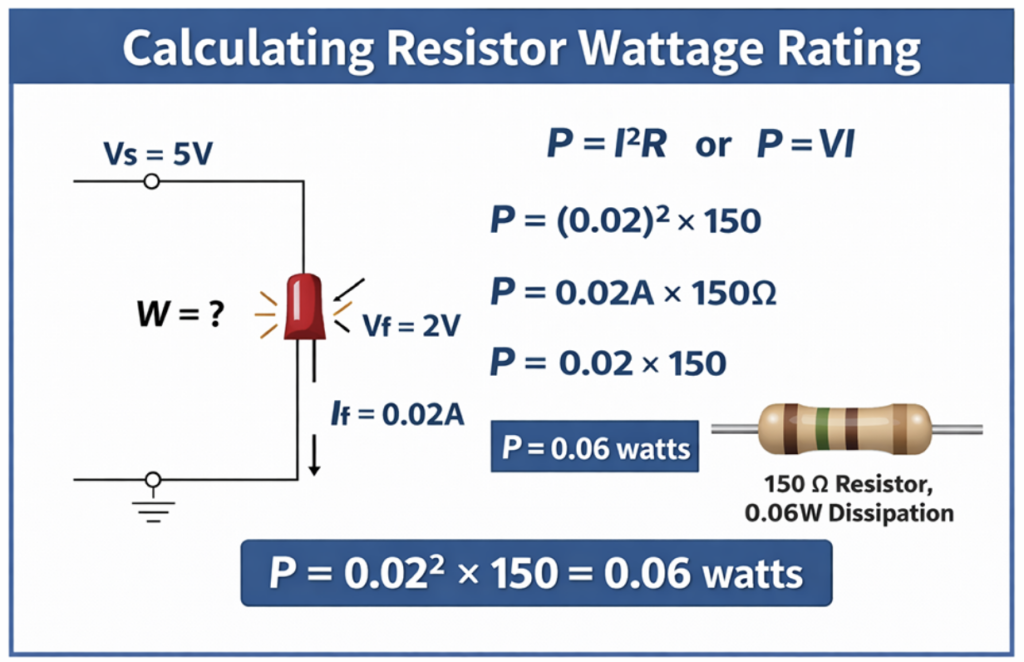
R = 150 ohms
You would then select the nearest standard resistor value. In this case, 150 ohms is already a common E24 series value.
Clear summary: Subtract the LED forward voltage from the supply voltage, then divide by the desired current.