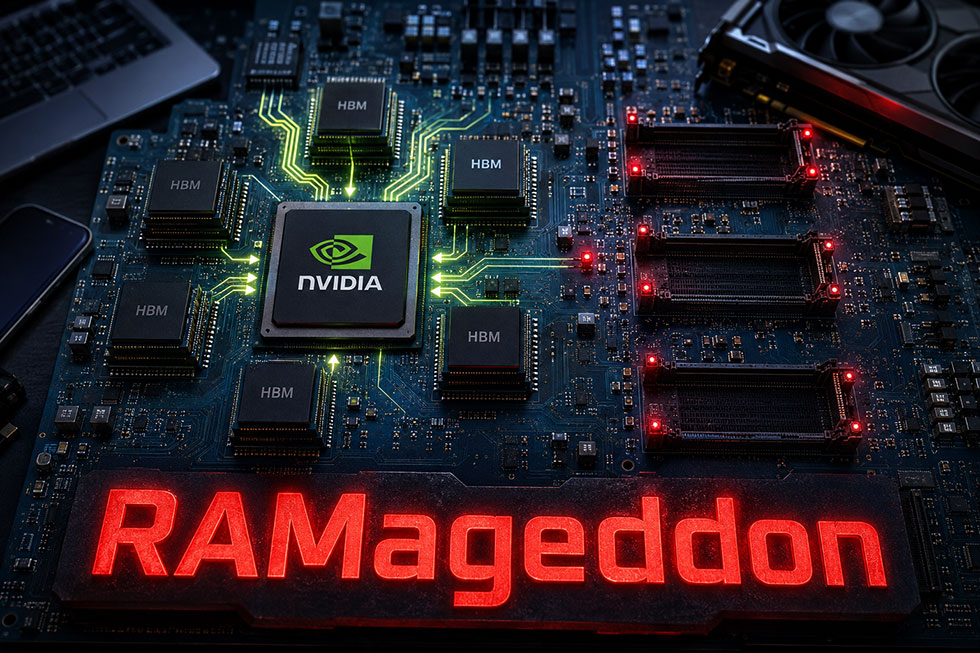
RAMageddon! Nvidia and AI Fuel Consumer Electronics DRAM Shortage

RAMageddon! Nvidia and AI Fuel Consumer Electronics DRAM Shortage Summit Electronics August 27, 2026

RAMageddon! Nvidia and AI Fuel Consumer Electronics DRAM Shortage

RAMageddon! Nvidia and AI Fuel Consumer Electronics DRAM Shortage

By Richard Rosenstein, Owner of Summit Electronics

Key Takeaways

  • AI-server prices may rise over 15% as memory costs climb and large systems absorb greater DRAM capacity.
  • The consumer electronics DRAM shortage is widening as producers direct capacity toward higher-margin HBM.
  • Device makers face higher costs or reduced memory across smartphones, computers, graphics cards, and gaming systems.
  • Early sourcing reduces production delays by giving buyers time to confirm specifications, secure inventory, and approve alternates.

The consumer electronics DRAM shortage has turned ordinary memory chips into the hottest seats in AI’s game of musical chairs. The main pressure comes from AI data centers, which consume large amounts of memory and reward suppliers for shifting limited production capacity toward higher-margin products. That leaves less standard memory for phones, computers, graphics cards, and repair inventories.

Don’t Let RAMageddon Stop Production. Source Critical DRAM Parts Now. GET A QUOTE TODAY!Nvidia is a major force behind this shift because its accelerators and rack-scale systems depend on HBM to move data rapidly between memory and GPUs. Some major customers were told AI-server prices could rise by more than 15%. 

Conventional DRAM contract prices were also projected to increase 58% to 63% quarter over quarter in Q2 2026 after a 90% to 95% rise in Q1. A mainstream 32GB DDR5-6000 kit reached about $392 in August, compared with $110 to $140 one year earlier.

Summit Electronics helps buyers respond before one missing part delays a production run or repair program. As an electronic components supplier, we stock more than 2 million current, allocated, hard-to-find, and obsolete parts. Our worldwide network supports OEMs, MRO teams, manufacturers, and repair facilities across many industries.

What RAMageddon Means for the Memory Market

DRAM holds active data while a device is running. DDR memory serves PCs and servers. LPDDR supports phones and portable devices. GDDR feeds graphics processors. By comparison, HBM stacks several memory dies and places them close to an accelerator for much faster data transfer.

Samsung, SK Hynix, and Micron dominate DRAM production. When these companies assign more advanced fabrication, packaging, and testing capacity to AI-grade products, conventional supply tightens. 

This concentration makes DRAM semiconductors sensitive to large allocation changes. It also raises sourcing risks for buyers who need exact Micron memory components or older device generations.

Why HBM Demand Pulls Capacity From Standard DRAM

AI memory competes for wafers, packaging equipment, substrates, testing, and engineering resources. The company’s multiyear SK Hynix partnership includes memory co-development for Vera Rubin AI supercomputers, Vera CPUs, PCs, and robotic computing platforms.

The scale matters. A single AI server can require 8 to 10 times more DRAM than a traditional server. That demand places AI-related electronic components under pressure far beyond the data center.

As AI companies place larger memory orders and sign long-term supply agreements, manufacturers reserve more production capacity for high-bandwidth memory. That leaves fewer standard DRAM parts available, increases allocation pressure, and extends lead times. 

Higher production costs also move through the supply chain, raising prices for smartphones, laptops, graphics cards, and other consumer devices.

How the Consumer Electronics DRAM Shortage Hits Everyday Devices

RAMageddon affects several product categories at once:

  • Smartphones and tablets: Higher LPDDR costs can raise device prices or push manufacturers toward smaller memory configurations.
  • Laptops and desktops: Rising DDR4 and DDR5 costs increase bills of materials and make higher-capacity systems harder to price.
  • Graphics cards and gaming systems: Tight GDDR supply can raise card prices and disrupt planned product updates.
  • Repair and legacy programs: Older memory devices may become scarce even when installed equipment still has years of service life.

The effects also reach other consumer electronics components. Manufacturers still need power-management ICs, capacitors, switches, transistors, relays, and voltage regulators to complete each assembly.

What Procurement Teams Should Do Now

Treat memory as a schedule risk instead of a last-minute purchase.

  1. Audit bills of materials for memory parts and exact suffixes.
  2. Flag single-source devices and parts with no approved substitute.
  3. Confirm density, speed, voltage, package, and temperature requirements.
  4. Reserve near-term quantities based on approved production forecasts.
  5. Qualify alternates before a shortage stops production.
  6. Send complete part data to your electronic components supplier.

Our electronic parts supplier checklist can help your team prepare part numbers, quantities, date-code requirements, package details, photos, and acceptable alternates.

Frequently Asked Questions

What Is Causing the Consumer Electronics DRAM Shortage?

AI data centers require large memory volumes. Manufacturers are assigning limited fabrication and packaging capacity to higher-margin AI and server products. Consumer, industrial, and legacy memory categories must compete for the remaining output.

Is Nvidia Solely Responsible?

No. The company drives significant AI accelerator demand, but hyperscaler expansion, limited fab capacity, supplier allocation, advanced packaging constraints, and long-term contracts also affect availability.

How Long Could Memory Supply Remain Tight?

Pressure may continue into 2027. Leading suppliers have already committed large portions of production, and new fabrication facilities take years to reach full output.

Can Older Memory Parts Still Be Sourced?

Yes, but availability depends on the exact part number, package, speed, voltage, and required quantity. Early sourcing gives buyers more time to verify stock or approve a compatible alternative.

summit-logo

How Summit Electronics Helps Source Constrained Parts

Summit Electronics has supported component buyers since 1961. As an electronic components supplier, we source semiconductors, diodes, transistors, IGBTs, MOSFETs, switches, capacitors, electron tubes, power rectifiers, SCRs, integrated circuits, relays, and voltage regulators.

We supply new and legacy parts for military, aerospace, robotics, energy, consumer products, and MRO repairs. Our team combines worldwide purchasing reach with fast quote responses, personal service, competitive pricing, and part-number accuracy.

Do not wait for an allocation notice to expose gaps in your bill of materials. Send us your part numbers, quantities, and delivery requirements. Summit Electronics can help you find current, hard-to-find, and obsolete components before a shortage delays your next build.

At Summit Electronics, we are meeting difficult demand through stocked inventory, worldwide sourcing access, fast responses, and part-number-level support. Click here or call us toll-free at (800) 226-6960.